RPC nodes are a critical part of blockchain infrastructure. They allow wallets, decentralized applications (dApps), and backend systems to read blockchain data and send transactions without running a full node locally.
If you’ve ever checked a wallet balance, signed a transaction, or interacted with a smart contract, an RPC node was involved.
This guide explains what an RPC node is, how it works, why it matters, and which types exist, using clear language and practical examples.
What Is an RPC Node?
An RPC node (Remote Procedure Call node) is a blockchain node that exposes an interface allowing external applications to interact with a blockchain network.
Instead of downloading the entire blockchain or managing consensus logic, apps send structured requests to an RPC node, which returns the required data or broadcasts transactions on their behalf.
In short, an RPC node:
- Receives requests from applications
- Reads blockchain state (blocks, balances, transactions)
- Sends signed transactions to the network
- Returns responses in a standardized format
How RPC Nodes Work
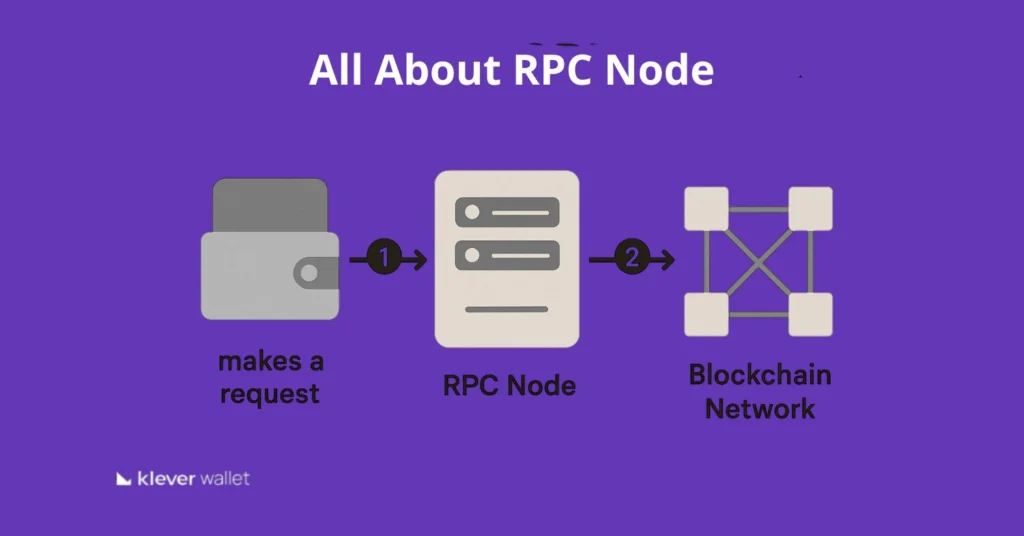
RPC nodes act as a bridge between blockchain applications and the network itself.
Most RPC nodes use JSON-RPC, a standard way for applications to send and receive information using simple data messages over the internet (via HTTP or WebSocket).
What happens in practice
- A wallet or dApp makes a request
For example, it asks: “What’s the balance of this address?” or “Send this signed transaction.” - The RPC node handles the request
The node checks its up-to-date copy of the blockchain to find the information or prepare the transaction for the network. - The node sends back a response
The app receives the balance, transaction status, or confirmation that the transaction was submitted.
Because of this setup, applications don’t need to connect directly to many other computers in the network. They simply talk to an RPC node, which takes care of the heavy work in the background.
This makes blockchain apps faster, simpler, and easier to use for both developers and users.
RPC Node vs RPC Endpoint
Although often used interchangeably, these terms are different:
- RPC Node: The server running blockchain software (execution client).
- RPC Endpoint: The URL used by applications to send RPC requests.
The endpoint is simply the access point to the node’s services.
Common RPC Node Requests
RPC nodes support a wide range of operations, including:
- Reading account balances
- Fetching block and transaction details
- Calling smart contract functions (read-only)
- Broadcasting signed transactions
- Subscribing to on-chain events (via WebSockets)
These functions are essential for wallets, explorers, DeFi platforms, NFT marketplaces, and backend analytics systems.
Types of RPC Nodes
1. Public RPC Nodes
- Free and open access
- Often rate-limited
- Suitable for testing and low-traffic apps
2. Private or Dedicated RPC Nodes
- Exclusive access for one project
- Higher reliability and performance
- Used in production environments
3. Full, Archive, and Light Nodes
- Full nodes: Store recent blockchain state
- Archive nodes: Store complete historical data
- Light nodes: Rely on other nodes for data
Archive RPC nodes are commonly used by explorers and analytics platforms that need historical information.
Why RPC Nodes Are Essential
RPC nodes are the backbone of blockchain usability because they:
- Enable wallets and dApps to function efficiently
- Reduce infrastructure complexity for developers
- Allow scalable access to blockchain data
- Improve user experience through faster responses
Without RPC nodes, most applications would require users to run local nodes, which would severely limit adoption.
RPC Nodes and Decentralization
While blockchains are decentralized at the protocol level, RPC access can become centralized if most apps rely on a small number of providers.
To mitigate this risk, many projects:
- Use multiple RPC endpoints
- Rotate providers automatically
- Encourage users to configure custom RPC URLs
This improves resilience and reduces dependency on a single infrastructure provider.
Popular RPC Node Providers
Some widely used RPC infrastructure providers include:
- Alchemy
- Infura
- QuickNode
- Ankr
- dRPC
- Chain-specific community RPCs
These services manage node uptime, scaling, and performance so developers can focus on application logic.
RPC Nodes in Practice
In real usage:
- Wallets connect to RPC endpoints to display balances and send transactions
- dApps use RPC nodes to interact with smart contracts
- Indexers and analytics tools rely on archive RPC nodes for historical queries
Every on-chain interaction starts with an RPC request.
RPC Nodes and the Role of Klever in Blockchain Access
RPC nodes are a foundational layer of blockchain infrastructure. They enable wallets, dApps, and backend systems to interact with decentralized networks efficiently, without forcing users to manage complex node setups or maintain full blockchain data locally.
This is where solutions like Klever play an important role. By integrating reliable RPC infrastructure directly into its ecosystem, Klever ensures that users can access blockchain data, sign transactions, and interact with smart contracts smoothly across multiple networks — all while maintaining self-custody and security.
For developers, this means fewer infrastructure concerns and consistent performance. For users, it translates into faster responses, stable connectivity, and a seamless on-chain experience.
As blockchain adoption grows, robust RPC access becomes increasingly important — and platforms that abstract this complexity responsibly help bridge the gap between decentralized networks and everyday use.