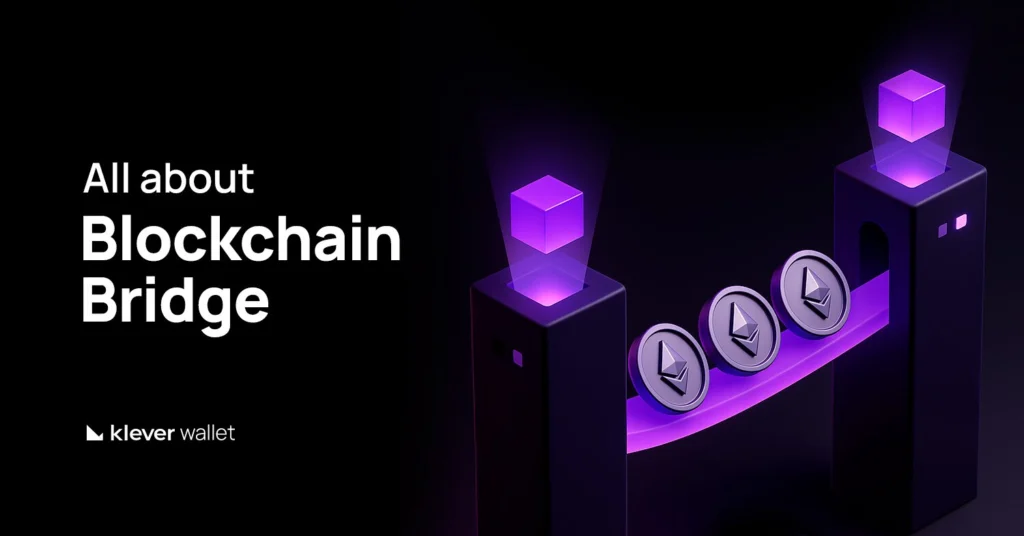
A Blockchain Bridge is a protocol that enables interoperability* between blockchains — in other words, it connects different networks so users can transfer tokens, data, and information securely.
Since each network operates independently, the bridge works as the technology that allows an asset from one blockchain to be used on another without relying on centralized intermediaries.
This type of technology has become essential for Web3 because it broadens utility, lowers costs, and changes how users interact with multiple blockchains in their daily routine.
As a result, assets gain more use cases, fees become lower, and users can access applications that were previously locked inside isolated ecosystems.
How a Blockchain Bridge Works?
There are two main types of bridges used today: those that create wrapped tokens (lock-and-mint) and those that operate through liquidity pools. Each one solves interoperability in a different way.
1. Lock-and-Mint (Wrapped Tokens)
The lock-and-mint model is the most common today, especially among EVM-compatible blockchains.
Here’s how it works:
- The original token is locked in a secure smart contract on the source chain (similar to a digital “vault”).
- The bridge then creates an equivalent token on the destination chain — the well-known wrapped token — with the same value as the original.
- When the user wants to return to the initial network, the wrapped token is burned, and the original token is unlocked in the smart contract and sent back to the user.
This model is widely used across the market. Two well-known examples are WBTC (Wrapped Bitcoin) and renBTC, which allow Bitcoin to be used on Ethereum-compatible blockchains.
Another common case is wETH (Wrapped Ether), the version used in applications that require the ERC-20 standard.
This process enables cross-chain operations, allowing the same asset to move across different ecosystems. Only one version — the locked or the wrapped one — exists at any given time.
2. Liquidity-Based Bridge
The liquidity-based model works without locking the original token.
It uses pools that hold token reserves across different blockchains. These pools exist specifically to serve users who need to move assets quickly.
The flow is simple:
- The user sends a token to the bridge.
- The bridge delivers the equivalent amount directly from the destination chain’s pool, with no need to mint a wrapped version.
- Everything depends on how much liquidity is available in those pools.
This approach is usually faster, but it requires the bridge to maintain large reserves to meet demand.
Some of the most popular examples include ThorChain, which enables direct swaps of native assets between blockchains, and Synapse, which provides a strong pool-based structure for fast transfers across networks.
Difference: Liquidity Bridge vs. Lock-and-Mint
| Aspect | Lock-and-Mint (Wrapped Token) | Liquidity-Based Bridge |
| How it works | Locks the original token in a smart contract and creates an equivalent wrapped token on the destination chain. | Uses liquidity pools across multiple blockchains and sends the equivalent token directly from the pool. |
| Speed | Can be slower due to smart contract execution and network congestion. | Usually faster since there is no mint/burn process and tokens are already available in the pools. |
| Costs | Can have higher fees because it depends on complex smart contract interactions. | Tends to be cheaper, with fewer steps and lower contract usage. |
| Security | Depends on the strength of the smart contract; if the vault is secure, the original token remains protected. | Depends on the integrity of pools and validators; vulnerable to low liquidity or poor management. |
| Common risks | Contract bugs, failures in the mint/burn process, fake wrapped tokens. | Empty pools, attacks on the validation system, poor reserve management. |
| Behavior during crises | Original tokens remain locked; issues mainly affect the wrapped token’s value. | Withdrawals may halt if the pool drains; price swings can occur. |
| Real examples | WBTC, renBTC, wETH. | ThorChain, Synapse. |
| Best for | Users who want predictability and EVM-compatible assets. | Users who prioritize speed, lower fees, and quick operations. |
| Common use cases | Bringing assets to EVM-compatible chains via wrapped tokens. | Moving native tokens across different networks without creating wrapped versions. |
Why Blockchain Bridges Matter
Three factors summarize their importance:
1. Connecting Blockchains
Bridges are essential for enabling cross-chain* functionality in Web3, linking networks that previously operated in isolation.
2. Access to dApps and Lower Fees
Users can move a token to another network to:
- access exclusive dApps,
- pay lower transaction fees,
- participate in DeFi protocols,
- perform stablecoin arbitrage.
3. Expanded Use Cases
NFTs, blockchain games, staking platforms, institutions, and enterprise solutions rely on bridges to integrate features and extend the reach of applications.
Most Common Use Cases
Here’s a quick overview of the most frequent day-to-day uses of a Blockchain Bridge:
- Transferring tokens between different networks
- Accessing dApps available only on another blockchain
- Moving assets to networks with lower fees
- Fast transfers of stablecoins
- Using NFTs across multiple ecosystems
- Integrating Layer 1 and Layer 2 networks (e.g., Ethereum ↔ Arbitrum)
Main Risks of Blockchain Bridges
Despite the benefits, bridges carry risks that require attention:
1. Attacks and Exploits
Some of the largest hacks in the industry involved bridges because they hold high concentrations of assets.
2. Smart Contract Failures
Errors in the code can compromise the locking, minting, or validation of tokens.
3. Low Liquidity
Liquidity-based bridges need constant reserves; when liquidity drops, transfers may fail.
4. Dependency on Validators
In some models, external validators decide whether a transaction is legitimate. If they fail or act maliciously, assets become vulnerable.
Where Blockchain Bridges Fit in the DeFi and DEX Ecosystem?
Blockchain Bridges are a crucial part of the infrastructure that powers DeFi and decentralized exchanges (DEXs).
In the decentralized finance ecosystem, a DeFi bridge connects users to liquidity pools distributed across multiple networks.
These bridges make it possible to:
- access liquidity pools that exist on other blockchains,
- move stablecoins to capitalize on arbitrage opportunities,
- participate in protocols that aren’t available on the original network,
- use blockchains with lower fees and higher speed,
- expand liquidity and enable assets to circulate more freely across several networks.
In DEXs like Uniswap, Curve, PancakeSwap, and Raydium, liquidity is spread across different chains. To trade in these environments, users must bring their assets to the blockchain where the pair is available.
This is exactly where bridges become essential: they allow capital to move freely, making transactions possible and expanding the reach of DeFi.
The Role of Bridges on Klever Blockchain
Many bridges in the market are EVM bridges, created to connect blockchains that follow the Ethereum standard.
Klever’s bridge allows users to bring tokens from Ethereum-compatible networks (EVM chains) into Klever. This lets you move assets without relying on exchanges and with much lower fees.
Klever developed the KVM (Klever Virtual Machine), the part of the blockchain responsible for running smart contracts, issuing tokens, and enabling new types of applications.
The KVM is based on WASM (WebAssembly), a modern and fast technology for developers and users submitting transactions.
Even without being an EVM, Klever offers an official bridge that connects Ethereum-compatible networks to the Klever Blockchain. This means:
- tokens can be transferred from other chains into Klever,
- users gain a more affordable way to move their assets,
- projects can bring their tokens to an environment with lower fees.
Bridges are essential for moving assets across blockchains, accessing a wide range of dApps, and reducing costs. For users who want these capabilities with lower fees, Klever’s bridge provides smooth integration with EVM networks and supports fast transactions through KVM.
Bridges and the Evolution of the Multichain Experience
Bridges have become one of the key components of Web3, enabling users to move tokens across blockchains, access exclusive protocols, and benefit from networks with lower costs.
This shift expanded the utility of nearly any asset running on a public blockchain.
For users who want to take advantage of this interoperability with lower fees, Klever Blockchain offers a bridge integrated with EVM networks and compatible with fast operations through KVM — making it easy and efficient to move assets in a multichain environment.
FAQ — Frequently Asked Questions About Blockchain Bridges
(Based on real search behavior and common Google variations, without restricted wording)
What is a Blockchain Bridge?
A protocol that connects two or more blockchains to transfer tokens and data between different networks.
What is a Blockchain Bridge used for?
It allows users to move assets from one blockchain to another, access exclusive dApps, lower fees, and expand token utility.
How does a Blockchain Bridge work in practice?
It usually operates through two methods:
- lock-and-mint: the original token is locked and an equivalent is created on the other network,
- liquidity: pools provide the equivalent token without requiring a lock.
Are Blockchain Bridges safe?
It depends on the model. Bridges can be secure when audited, but they have been targeted by attacks, so caution is necessary.
What are the risks of using a bridge?
Smart contract failures, exploits, low liquidity, validator dependency, and counterfeit wrapped tokens.
What’s the difference between a bridge and a swap?
A swap exchanges one asset for another within the same network.
A bridge transfers an asset to a different blockchain.
Can I use any token on any network with a bridge?
No. Availability depends on the bridge’s compatibility with the networks and tokens involved.
Is a wrapped token the same as the original token?
No. It represents the original token but exists only on the destination chain as a 1:1 equivalent.
Why are bridges important for DeFi?
They enable access to protocols available only on other chains, move liquidity, and open opportunities outside the native blockchain.
Mini Glossary of Essential Terms
Interoperability
The ability of different blockchains to communicate, exchanging tokens, data, or information securely. It allows the same asset to be used across multiple ecosystems without relying on centralized intermediaries.
Wrapped Token
A representative version of an original asset on another blockchain. It maintains a 1:1 value equivalence and exists only while the original token remains locked in a smart contract. Examples: WBTC, renBTC, wETH.
Liquidity
The amount of a token available in pools or markets to enable fast transactions without major price fluctuations. In liquidity-based bridges, transfers only work when reserves are sufficient to serve users.
Cross-chain
A set of operations that allow tokens to move across different blockchains. Cross-chain solutions are essential for DeFi, DEXs, and practical usage of applications across multiple networks.