
The week opened with anticipation and closed with intensity on crypto market. Over just a few days, the crypto market faced breaks of key support levels, adjustments triggered by the Federal Reserve’s latest remarks, capital outflows, and fresh regulatory debates that pushed investors into a cautious stance.
Each development sparked a different reaction — and together, they shaped a landscape that calls for careful attention.
With so much happening at once, understanding what truly drove these shifts becomes essential.
This update brings together the factors behind the recent moves, explains why they unfolded the way they did, and highlights what to watch next — all in a clear, objective format grounded in the most relevant data available. Let’s dive into the full picture.
Bitcoin Today (12/12/2025): Current Price, News, and Market Analysis

Source: CoinMarketCap
Bitcoin opened the day near $92,500, but it saw a sharp drop of roughly $2,600 in less than an hour this Friday (12), sliding to $89,700. The move drew attention because it broke a short-term support level and intensified intraday volatility.
Why Bitcoin Fell Below $90,000
According to CoinDesk, Bitcoin’s dip below $90,000 was influenced by a broader shift across financial markets. The main trigger came from the tech sector, which faced heavy pressure after renewed concerns surrounding artificial intelligence companies.
This downturn dragged the Nasdaq, an index heavily weighted toward tech firms — and when the Nasdaq experiences a strong pullback, the impact often spills over into cryptocurrencies, especially Bitcoin.
Why Bitcoin Fell Below $90,000 This Week (and What Pulled Ether Down With It)
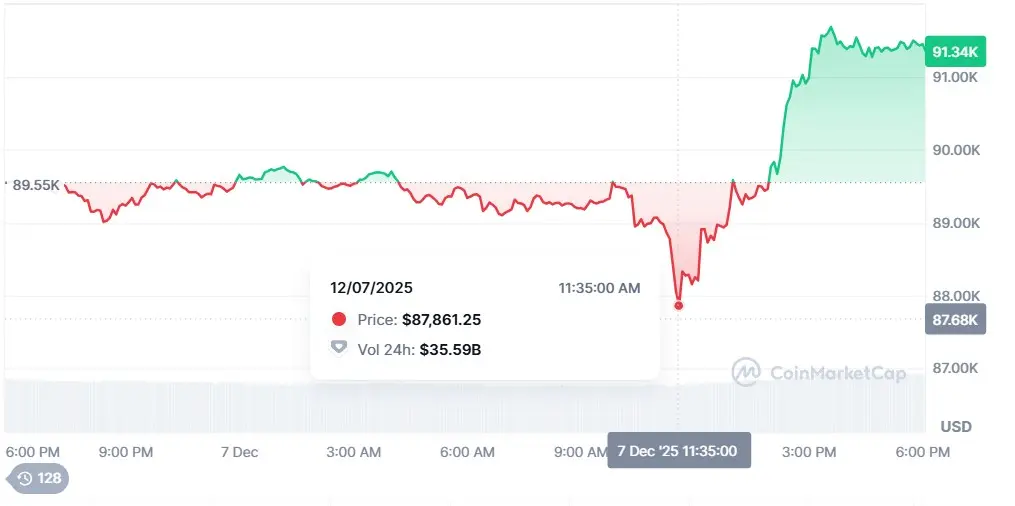
Source: CoinMarketCap
Bitcoin repeatedly slipped under the $90,000 support level throughout the week, pressured by capital leaving higher-risk assets after the Federal Reserve’s latest decision.
Even with a 0.25-point rate cut, the Fed’s more cautious tone cooled short-term expectations and pushed many investors to take profits. As a result, BTC ended Thursday once again near the critical $90,000 zone.
Ether also faced a steep drop, moving in line with Bitcoin. Beyond the macro backdrop, analysts highlighted a slowdown in inflows to institutional products linked to the Ethereum ecosystem, which added further selling pressure over the week.
Key Factors That Shaped the Market
• BTC dropped through important levels after waves of selling in risk assets.
• The Fed’s communication lowered expectations of a quick rebound.
• ETH followed due to reduced institutional demand.
• Overall market sentiment turned more defensive after the announcement.
Total Crypto Market Cap Drops: What’s Behind This Week’s Correction
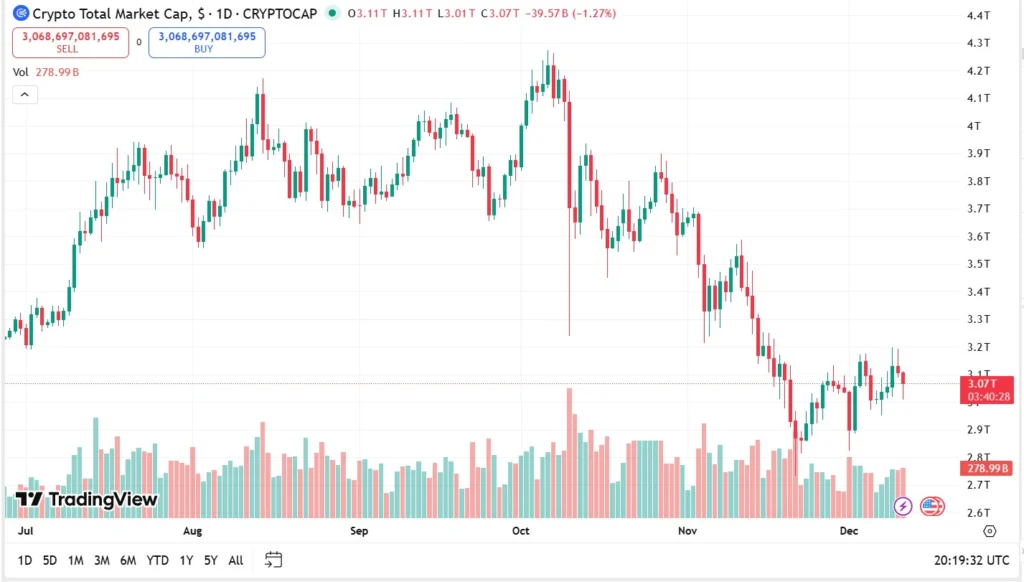
Source: TradingView
The global cryptocurrency market cap declined throughout the week, indicating that selling pressure affected not only Bitcoin and Ether but also several major tokens.
The current total market cap stands near $3.07 trillion, reflecting a drop of roughly 2.5% compared to the previous week.
This movement reinforces a broader pullback, as investors reduced exposure after new signs of caution in the macroeconomic environment. The shift shows a lower appetite for risk, with many traders choosing more defensive strategies following the latest communication from the Federal Reserve. A mix of profit-taking, weaker buy flows, and rising volatility contributed to the sector-wide decline.
Why the Crypto Market Cap Fell
• Capital outflows hit several large-cap tokens.
• Lower demand for higher-risk assets.
• Caution after the Fed’s recent decision.
• Increased volatility encouraging protective moves.
This overview helps clarify the drivers behind the market’s decline and how macro factors continue to shape the behavior of major digital assets.
Fed Cuts Rates by 0.25 Point, but Cautious Guidance Limits Crypto Market Reaction

The Federal Reserve lowered interest rates by 0.25 point, but the move was already widely anticipated by investors. According to Barron’s, the key factor shaping crypto performance wasn’t the cut itself — it was the more restrained guidance shared by Fed officials right after the announcement.
Instead of signaling additional cuts or a more supportive stance, policymakers emphasized uncertainties surrounding the economic outlook. This reduced short-term expectations for digital assets and weakened the upward momentum many traders were waiting for in Bitcoin, Ether, and other cryptocurrencies.
Why the Fed’s Rate Cut Didn’t Lift the Crypto Market
• The 0.25-point cut was fully priced in.
• The official communication avoided promises of further stimulus.
• The macro landscape became more limited, reducing appetite for risk.
• Digital assets reacted with volatility and loss of momentum.
Bitcoin Returns to the $90,000 Range After Fed Rate Cut Fails to Generate Upward Momentum
Bitcoin moved back into the $90,000 range after the market adjusted expectations following the Federal Reserve’s 0.25-point rate cut.
The decision was entirely anticipated, limiting any chance of a meaningful short-term rally.
The decisive factor was the Fed’s more restrained guidance during the press conference. Instead of signaling additional cuts, officials highlighted uncertainties about future monetary steps. This tone curbed optimism and led many traders to scale back positions, weakening the momentum that could have held Bitcoin above current levels.
Why BTC Returned to $90,000
• The rate cut was already fully priced in.
• The official guidance leaned more cautious than supportive.
• Investors reduced exposure to more volatile assets.
• Demand for BTC weakened after the Fed’s press briefing.
SEC Approves Tokenization of Stocks in the U.S.: What This Means for the Market

The SEC has given the green light to a pilot program that allows the tokenization of stocks and traditional securities in the United States. The decision marks an important step toward integrating financial markets with blockchain technology, creating a new framework for digital asset trading and custody.
What the SEC Approved
The commission issued a no-action letter to the DTCC (Depository Trust & Clearing Corporation), authorizing the use of blockchain to record and manage financial assets without regulatory penalties during the pilot.
This approval allows:
• Creating tokens that represent stocks, Treasury bonds, and ETFs
• Recording ownership of these assets directly on an approved blockchain
• Converting traditional securities into tokenized versions in a secure and auditable way
How the SEC-Approved Tokenization Works
The pilot will run for an initial three-year period. The DTCC will be able to:
• Convert stocks and bonds into digital tokens with full legal equivalence to the original assets
• Operate the system with participants who choose the tokenized model
• Use institution-controlled wallets to reverse transactions in cases of error or fraud
Even in tokenized form, the assets maintain all rights related to ownership, settlement, and collateral recognized by U.S. regulators.
Which Assets Will Be Tokenized
The pilot includes highly liquid assets, such as:
• Companies in the Russell 1000 index
• U.S. Treasury securities
• Widely traded ETFs
This selection reduces operational risk and supports broad adoption.
Why This Matters for the Market
The SEC’s approval is significant because it:
• Cuts settlement and reconciliation costs
• Improves transaction efficiency, allowing near-instant settlement
• Modernizes financial infrastructure, with DTCC adopting blockchain at scale
• Signals regulatory openness under strict compliance controls
Pilot Limitations and Controls
The program does not create an open market. Key limits include:
• Only blockchains that meet strict technical and governance standards may be used
• Root-controlled wallets ensure transaction reversibility and compliance
• Tokenization is optional and does not immediately replace current systems
What This Decision Could Mean for the Future
If the pilot succeeds, it may lead to:
• Broader institutional adoption of tokenization
• Same-day settlement (T+0) becoming standard
• Faster integration between blockchain and traditional finance
• Expansion into structured products and corporate credit derivatives
The SEC — traditionally cautious — now shows gradual openness to digital infrastructure, reinforcing a global trend toward asset digitalization.
MSCI Considers Excluding Companies Holding Large Bitcoin Reserves — and the Crypto Sector Responds
MSCI is evaluating whether to remove companies with significant Bitcoin holdings from its indexes, a proposal that sparked strong reactions across the crypto industry. According to Business Insider, companies and specialists argue that such exclusion misinterprets the role of BTC in corporate strategy, as many adopt it for treasury management, inflation protection, or long-term reserve purposes.
The main concern is that the change could reduce institutional interest. Index-linked funds may be forced to sell positions in these companies, directly affecting liquidity and market value.
Why MSCI’s Proposal Raises Concerns
• Companies could be removed from indexes widely used by global funds.
• The interpretation of Bitcoin reserves would be distorted, affecting risk perception.
• Institutional investors might reduce exposure due to portfolio requirements.
• Liquidity and market value of these companies would be directly impacted.
This debate became a key topic this week and is crucial for those following how index policies influence the crypto market and companies that adopt Bitcoin as part of their balance sheet.
DEX Activity Remains Strong, but Security Incidents Like the Upbit Hack Still Weigh on the Sector
According to DL News, trading volumes on DEXs and on-chain activity remain important indicators for tracking the crypto landscape. Activity is still elevated across several networks, showing that many users continue to favor peer-to-peer trading.
However, confidence is still affected by security breaches recorded in recent years. A notable case resurfacing this week is the Upbit hack, involving one of South Korea’s largest exchanges. The incident reignited discussions about user protection and pushed regulators in the country to tighten oversight, increasing pressure on both centralized and decentralized platforms.
Why This Matters for the Market
• DEXs continue to show strong volumes and high daily usage.
• On-chain activity remains a key metric for sector health.
• Security incidents still influence user confidence.
• South Korea increased regulatory scrutiny after the Upbit case.
This scenario reinforces that, despite growth in DEX adoption and expanding on-chain usage, security and regulation continue to shape how investors interact with the ecosystem.
What This Market Moment Teaches — and How Klever Wallet Helps You Stay in Control
The events of the week illustrate how Bitcoin remains sensitive to macro decisions, institutional liquidity, and short-term support breaks.
The sharp move below $90,000, the reaction to the Fed’s tone, the decline in total market capitalization, and the regulatory discussions — from the SEC to MSCI — highlight the importance of caution, risk management, and tools that provide real autonomy.
In this environment, having a wallet that allows you to monitor the market, move assets quickly, and maintain direct custody becomes essential.
Klever Wallet delivers exactly that by offering features that help you react swiftly as conditions change:
As the market continues to respond to Federal Reserve decisions, institutional pressures, and new regulatory developments in the U.S., Klever Wallet becomes a reliable and flexible point of control for anyone who wants to operate responsibly, follow trends, and keep their assets protected with convenience.